EradiFluor
You need a way to destroy PFAS, not just concentrate or transfer them. Enter EradiFluor, Haley & Aldrich’s efficient, cost-effective PFAS-destruction technology.
Why EradiFluor?
Efficient PFAS destruction with no harmful by-products
EradiFluor has shown a defluorination rate of almost 100 percent, exceeding that of many other technologies. EradiFluor treatment destroys long-, short-, and ultrashort-chain PFAS.
Many other technologies simply concentrate or transfer PFAS (also known as per- and polyfluoroalkyl substances), which means the substances still need to be disposed of.
EradiFluor destroys PFAS with no harmful by-products (e.g., perchlorate and bromate) that would require additional expensive treatment.
Lower energy use
EradiFluor relies on ultraviolet (UV) light and common chemicals to destroy PFAS. This process operates under ambient pressure and low temperature (less than 60 degrees C) and uses less energy than other technologies — saving money and supporting sustainability goals.
Safer to operate
The technology operates under ambient pressure and in low temperatures, unlike the many alternative destructive technologies that require high temperature and high pressure — and hence special health and safety measures — to operate.
Flexible, scalable implementation
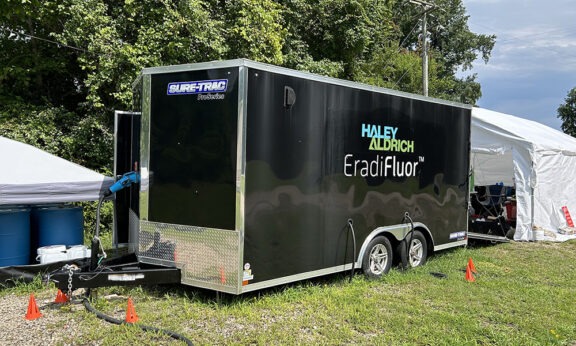
Customers can build as many small-footprint units as needed on-site or can ship waste to a central location.
Backed by highly competitive funding
We developed this technology with financial support from the Department of Defense’s Environmental Security Technology Certification Program and the Air Force Civil Engineering Center, which require rigorous peer review and vetting.
What can EradiFluor treat?
- Membrane filtration rejectate
- Foam fractionate
- Industrial wastewater
- Ion exchange resin regeneration brine
- Activated carbon regeneration residue
- AFFF rinsate residue
- Residue from soil washing
- Other concentrated PFAS waste
How does EradiFluor work?
See us at work
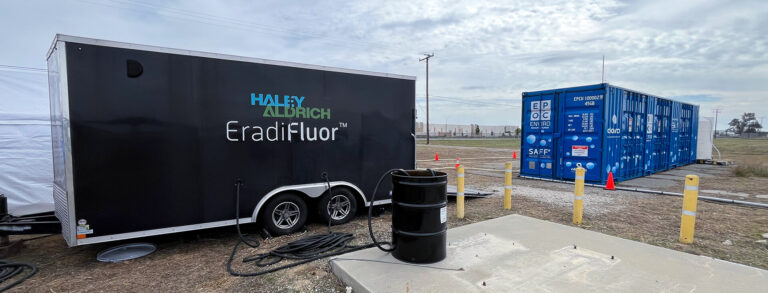
U.S. Air Force · Southern California
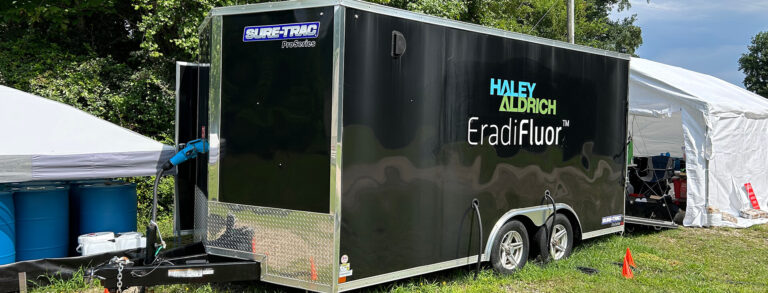
U.S. Navy · Eastern United States
View related resources