Key takeaways:
- EPA Brownfields funding will drop 76% in FY2027, meaning smaller, more competitive grants.
- Applications open in fall 2026 with a 60-day completion window.
- Position yourself for success now by building a site inventory, forming partnerships and seeking matching dollars, and getting feedback from EPA officials.
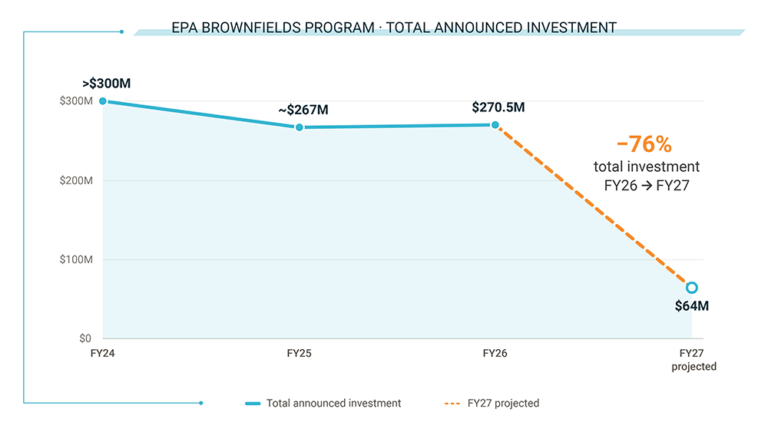
After five years and $1.5 billion in funding from the Bipartisan Infrastructure Law (BIL), the U.S. Environmental Protection Agency’s (EPA) Brownfields Program is returning to pre-BIL funding levels. Following $270.5 million in awards in FY2026, EPA will award a projected $64 million in FY2027, a 76% decrease. Grants will be smaller and more competitive. That said, that $64 million needs to go somewhere, and that somewhere could very well be to your community. Applications will open in fall 2026 and be due 60 days later. To position your community to compete optimally, start now.
In the article that follows, we’ll review recent changes in the EPA Brownfields grant program, how to prepare for the upcoming cycle, and actionable insider tips to take your application to the next level.
What’s new with the EPA Brownfields program this year?
On June 24, EPA announced the results of its FY2026 Brownfields grant competition, which marked the last cycle in which the agency offered historically large grants made possible by the BIL. EPA awarded 224 grants worth $270.5 million to 221 tribes, nonprofits, and local governments. Haley & Aldrich authored six successful grants, winning $14.5 million for five public entities in four states. Notably, our team wrote one-quarter of the largest Cleanup Grants awarded nationwide, each worth $4 million.
Moving forward, the FY2027 EPA Brownfields grant competition will depend solely on congressional appropriations. Due to the FY2027 funding decrease to approximately $64 million, we anticipate a 52% decrease in the number of competitive brownfield grants awarded and a 76% decrease in total announced investment. Table 1 summarizes EPA’s projected FY2027 awards.
Estimated EPA FY2027 Brownfields grant awards:
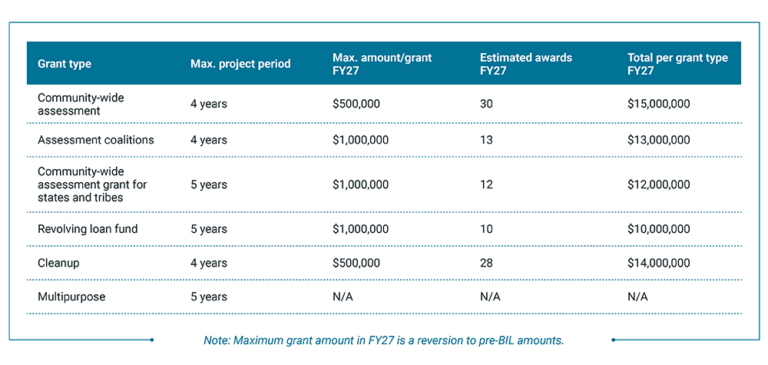
Source: Multipurpose, Assessment, RLF, and Cleanup Grant Application Resources | US EPA
In addition to providing additional funding, the BIL temporarily suspended cost-sharing requirements, which are expected to return in FY2027, meaning we anticipate that a 20% match will be required for Cleanup and Revolving Loan Fund (RLF) applicants.
Because this next grant cycle will be so competitive, it’s critical to pre-position your team and your project for success now.
Setting up for success
An application for EPA Brownfields funding is a significant undertaking, and planning early is critical. Regardless of the type of funding for which you intend to apply, there are steps you can take today to be prepared for this fall.
Develop an inventory. This is a critical task for any entity seeking assessment funds. Whether in GIS, in Excel, or via free online tools like Kansas State University’s free app-based Brownfields Inventory Tool, start gathering information about your priority sites. Remember that the definition of “brownfield” is broad and can include real or perceived contamination. From that inventory, identify four to five priority sites and learn everything you can about them, such as size, past uses, existing infrastructure connections, zoning, proximity to sensitive environmental areas, proximity to economically distressed neighborhoods, community concerns (like dumping and other public nuisances), redevelopment interests (Does the surrounding area need housing? Retail? Jobs?), and relevant stakeholders. Where feasible, try to engage property owners to educate them about EPA’s Brownfields program and the brownfields redevelopment process.
Build partnerships. EPA’s application asks you to identify your key partners and their roles in your project. Start having conversations now to identify partners and solidify their roles. Try to assemble a mix of public, nonprofit, and private actors. Engage neighborhood groups from the areas around your priority sites, meet with public entities that have jurisdiction in those areas, and don’t forget local foundations or other groups that have a stake in redevelopment, such as housing developers (both for- and nonprofit) and public health authorities and advocates.
In addition to the practical effect of advancing your project, identifying your partners can help bring your story to life for EPA and make the project and its impact real for reviewers, so think broadly about whom to include. EPA reads hundreds of grant applications with similar information every year, so a good story about local need with the project-specific partners to back it up can make the difference and give your application an edge. For example, a sports league that has an interest in turning a brownfield into a park or an athletic field could be a key part of your team. In one successful grant our team authored, a kayaking group that served low-income families wanted access to a local waterway, which cleanup of our target site would help facilitate. Their partnership illustrated the project’s potential impact and added detail to the picture of community need.
Once upon a time, EPA accepted letters of support as part of the Brownfields grant application process. The agency ended that practice around a decade ago, but the actions you and your partners take now can communicate the same kinds of messages, and that has storytelling power. We’ve all heard that actions speak louder than words. When you have only 10 to 12 pages to tell your project’s story, the fact that you’ve taken preemptive actions to foster your project’s success and meet your community’s needs can form a powerful part of your narrative.
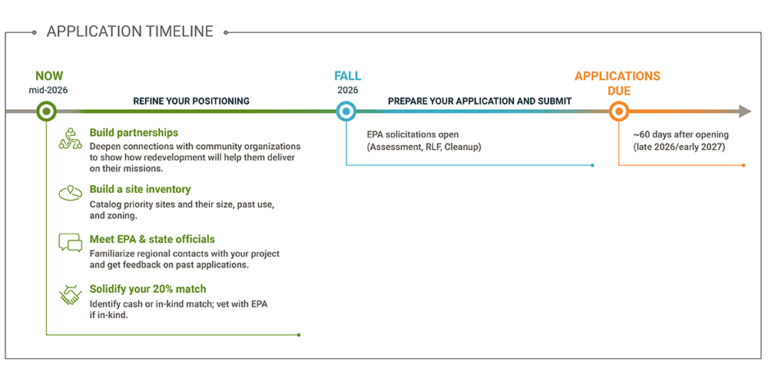
Meet with EPA and state officials. Your EPA regional team and state brownfields officials are your best advocates. Start talking with them now and get them familiar with your project and your needs. They have seen many brownfields projects come and go, and they can advise about what works, what doesn’t, and how to fix it. They may also have other ideas for you about funding.
Solidify your match. Cleanup and RLF grants require a 20% match, which can be in cash or in-kind. An in-kind match — which commonly includes staff time or materials — requires documentation, and it’s best to check your plan with EPA ahead of time, especially if you are being creative with the match. Understand the requirements, and be prepared to communicate how you plan to comply in your application. That way, you can be clear about your intentions without taking an unnecessary chance.
These steps may seem small, but they can make all the difference. Every funder wants to see their dollars as the critical factor that will make a project possible. So, the most compelling application will clearly communicate to EPA that your team is already working to advance brownfield redevelopment and that EPA’s investment is the keystone that will make the difference to your program. Your commitment to doing something to advance brownfield redevelopment when you have no grant speaks volumes about your ability to make redevelopment possible once you have dedicated resources.
Applied and weren’t awarded?
If you applied for FY2026 funding and weren’t awarded, we recommend immediately scheduling a debrief with EPA. The agency will not provide written comments, so be prepared to take copious notes. Make sure your debrief helps you understand exactly where you lost points and why. Once you’ve received feedback, consider reapplying. If you do choose to reapply, it’s essential that you thoroughly address all of EPA’s feedback. Rewriting can be a substantial effort, but it can make the difference: We’ve seen grants miss the mark by very few points and win upon resubmission after a client dissects EPA’s comments and integrates them into a revised application.
We can help
Last, consider pulling in a trusted advisor to support development of your application. Our team is always happy to brainstorm and help develop competitive strategies. We’ve helped communities secure funding for a wide variety of projects of all different types, needs, and sizes across the country. With a success record of 76% for EPA Brownfields grants, we’re always happy to put our expertise to work to help more communities make redevelopment visions a reality.

Published: 7/9/2026
Authors

Environmental Scientist

Technical Expert