
Key takeaways:
- An earlier CDP disclosure deadline next year — June 23, 2027 — will place added pressure on sustainability teams.
- Organizations can ease this crunch by beginning the sustainability reporting process earlier and managing it as a connected work stream with other disclosures, such as CDP.
CDP — a leading global sustainability disclosure platform focused on climate change, water security, and other environmental risks — has published its key 2027 disclosure cycle dates. Responses eligible for a score are due June 23, 2027 — nearly three months earlier than the 2026 scoring deadline.
An earlier CDP deadline in 2027 will place new pressure on sustainability teams. Organizations that begin report planning before year-end can reduce the spring crunch, improve data quality, and make both reporting processes more efficient.
CDP just made sustainability reporting season a lot tighter
Every sustainability reporting cycle begins with good intentions. Organizations set a publication date, use last year’s report as a starting point, and assume enough time for data collection and writing once the reporting year closes. Then the calendar tightens.
Foundational items that were settled in prior years get reopened for debate. Required disclosures may be missing from the draft or removed because they appear to add bulk, only to be added back in later when requirements are checked. Reviews begin before the content is truly ready, pulling teams into repeat review cycles as the document continues to change.
Before long, the reporting team is resolving structural questions while simultaneously drafting content, validating data, managing design, and securing approvals. By publication time, teams are exhausted, frustrated, and ready to avoid reporting until the next cycle.
In 2027, that familiar crunch will become even harder to manage. CDP’s 2027 deadline represents a significant shift from its recent reporting cycle, and the scoreable response window will be about one month shorter.
Calendars built around the later cycles of recent years no longer work. For many organizations, that timing means the final stages of sustainability report development will now overlap directly with CDP response development. Both efforts rely on many of the same people and inputs, including:
- Greenhouse gas (GHG) emissions data
- Environmental metrics
- Targets, policies, and performance narratives
- Governance information and risk assessments
- Legal and executive reviews
When processes start late or run separately, teams may repeatedly validate information, respond to competing requests, and reconcile inconsistencies as both deadlines approach. The solution is not to work faster — it is to begin earlier and manage sustainability reporting and CDP disclosure as connected work streams.
To ease the reporting crunch, begin work the prior year
Sustainability report development often doesn’t begin until January, after the previous reporting year is over and time is already restricted by financial reporting and year-end close. But ideally it should start much sooner. Teams need room to establish strategy and direction, gain internal alignment, and move work out of later phases during times when people are already overloaded.
Starting sooner means defining the next report’s goals and advancing work independent of final year-end data — not finalizing the performance story before the year ends.
Early efforts can focus on four areas:
- Reporting strategy and scope. Confirm the audience, publication target, boundaries, major changes from the prior report, and overall schedule.
- Frameworks, disclosures, and metrics. Confirm the standards and requirements that will guide the report, identify the disclosures to address, and establish the metrics and data owners needed to support them.
- Narrative development. Identify priority topics, highlights, and stories, then begin the actual writing for governance, strategy, program descriptions, and other sections that do not depend on final performance data.
- Reviews and decisions. Establish a staged review plan and surface known data gaps, methodology questions, or leadership decisions before they become late-stage blockers.
Extra time allows writers and subject-matter experts to thoughtfully develop narratives, align them with the reporting strategy, and refine content before deadline pressure builds. It is far more efficient than cobbling sections together faster and then reworking them during review because stakeholders have not had time to align.
Data collection can begin early, too. Collecting data monthly or quarterly helps organizations collect and review most annual data before the reporting year closes, streamlining reporting and reducing the year-end workload. Pulling data ahead of time can expose missing sources, inconsistencies, methodology questions, or unexpected trends while there is still time to address them. This is especially useful for time-intensive metrics such as GHG emissions, where activity data may come from multiple facilities, systems, vendors, or utility accounts. Once final year-end inputs are available, teams can complete calculations, validate trends, and finalize the performance story rather than starting the process from scratch.
Build your sustainability reporting program from a clear reporting baseline
For experienced reporters, continuity is deceptively difficult. Teams assume they can reuse last year’s metrics without confirming what actually was reported, whether those were the right metrics, and what each disclosure requires. A few things make the difference:
- A single source of truth. Year-over-year results carried forward exactly as reported in a structured spreadsheet, database, or platform rather than scattered across annual folders.
- An inventory management plan, called an IMP, for GHG data. Methods, boundaries, calculation approaches, ownership, and controls, all documented separately.
- Shared context between writers and SMEs. Marketing or communications teams often lead reports, so the people writing them do not own the data. A reliable review process and record of what was reported and why keeps established metrics from being dropped or mischaracterized.
- Framework mapping up front. Map disclosures to the selected framework(s) or regulatory requirements from the start. Mapping afterward tends to surface missing information and undocumented omissions and trigger late rewrites.
One sustainability data foundation, two deliverables
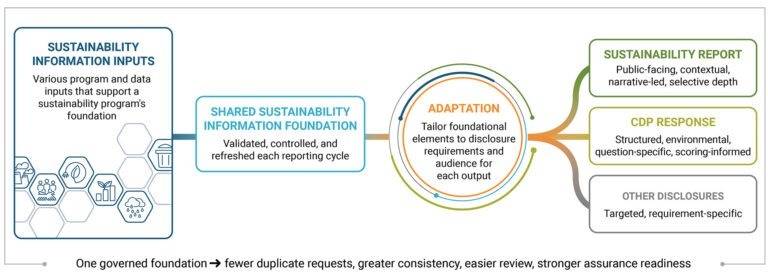
The sustainability report and CDP questionnaire are different deliverables, but they should have a shared foundation. Governance descriptions, GHG inventories, targets, risk information, methodologies, and performance explanations can be developed once, maintained in a controlled source, and adapted for each disclosure.
That approach reduces duplicate requests to internal teams, supports consistent boundaries and calculations, and allows validated sustainability reporting analysis to strengthen CDP responses. It does not mean every statement should be identical. A public sustainability report may emphasize accessibility and storytelling, while CDP requires more structured and detailed responses. The underlying facts, however, should tell the same story.
Work backward from the report publication date
Many organizations target Earth Day for publication — a difficult deadline if report development begins in February. Starting earlier makes the timeline more manageable and helps keep the most intensive report work from colliding with the heart of the CDP response period.
For an organization targeting a late-April report, the reporting cycle could look like this:
| Timing | Activities |
| January-October | – Regularly collect and validate data, addressing gaps and methodology questions as they arise. – Implement and document planned initiatives. |
| October | – Align the reporting team. Confirm objectives, scope, frameworks and disclosures, metric needs, content priorities, owners, and the review and approval plan. |
| November-December | – Start writing. Develop stable narrative sections, highlights, and stories. – Interview SMEs; if you haven’t yet started, begin available data collection and resolve methodology questions. |
| January-February | – Complete the core draft, with finalized year-end inputs and trend analysis. Finalize calculations. – Move through initial reviews and refine data-driven narratives. |
| March-April | – Complete reviews and begin design and production. The report should be in final stages when CDP opens April 14. |
| April-June | – Develop, review, and submit the CDP response using validated data, methodologies, and narratives from the reporting cycle. |
| June 23 | – Scoring deadline. |
The exact schedule will vary by organization, but the principle is consistent. Use the months before year-end to align the process, advance the writing, and gather available information so spring is reserved for finalization rather than foundational decisions.
Get ahead of the reporting crunch
Haley & Aldrich works with organizations to plan and execute sustainability reports and CDP disclosures, from early-cycle scoping and framework mapping through final publication and submission.
The 2027 CDP timeline may be arriving earlier, but the reporting cycle does not have to become more chaotic. If your organization plans to publish a sustainability report next year and hasn’t started planning yet, now is the right time to begin.
Our sustainability reporting team includes professionals with deep expertise in interpreting and applying different standards and frameworks. Specifically, the team can help with the Global Reporting Initiative, the Task Force on Climate-Related Financial Disclosures, and the Sustainability Accounting Standards Board.
Our broader sustainability team can support the full reporting process or help with specific needs. These include reporting strategy, project management, framework and disclosure mapping, narrative development, GHG inventories, metric calculations, data analysis, quality reviews, and CDP response development and submission.
By coordinating sustainability reporting and CDP disclosure as connected efforts, we reduce the burden on your teams. That improves consistency and builds a process that can be repeated and strengthened in future years.

Published: 10/6/2026
Authors

Senior Project Manager, Sustainability and Resilience

Senior Sustainability Strategy Advisor