
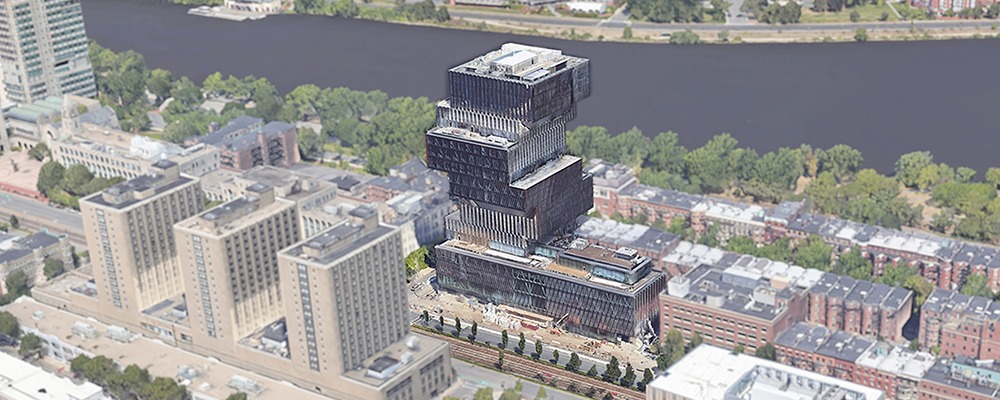
Key takeaways:
- Boston University’s Duan Family Center for Computing and Data Sciences is now a verified net-zero carbon building.
- Haley & Aldrich designed the borefield for its geothermal heating and cooling system.
- Since the building opened, it has outperformed its design energy use intensity.
Burlington, Mass., Sept. 22, 2026 — The New Buildings Institute has entered Boston University’s Duan Family Center for Computing and Data Sciences (CCDS) into its Getting to Zero Buildings Database, verifying the building’s status as a net-zero carbon emissions facility. Haley & Aldrich helped make this milestone possible for Boston University by designing the building’s geothermal borefield, which supplies most of the building’s heating and cooling.
The 19-story CCDS occupies a dense urban site on the university’s Charles River Campus that has limited space for a geothermal system big enough to meet ambitious net-zero emissions goals. Working with its mechanical engineering teaming partner, BR+A Consulting Engineers, Haley & Aldrich designed a closed-loop system of 31 boreholes drilled to 1,500 feet — among the deepest closed-loop geothermal systems in the country.
Since the system’s installation in 2022, it has met Boston University’s energy use intensity (EUI) goal, with a measured EUI of 40 Btu per square foot, outperforming the LEED target EUI of 42 Btu per square foot, based on 12 months of operating data. The geothermal system is operating within the design’s temperature range, enabling the university to adjust future operations for more geothermal exchange, reduce reliance on auxiliary sources of heating and cooling, further lower carbon emissions, and simplify the system’s heating and cooling controls.
The CCDS is now the third largest of more than 200 verified buildings on the New Buildings Institute’s list of zero-energy commercial and multifamily buildings across North America.
“The success of this project shows the possibilities of geothermal systems designed and built for constrained sites,” says Katherine Dilawari, a leader of Haley & Aldrich’s real estate market, which serves higher education clients. “Many urban universities and K-12 schools want to achieve net-zero milestones for their buildings but question the feasibility of geothermal systems as part of their planning. The CCDS shows that these systems can exceed design goals and serve as a lasting investment in decarbonization.”
For more information:
Contact our Media team.