What to know: Wildfires pose a host of risks, from financial loss to danger to human life. Organizations can manage those risks with planning, mitigation, and other proactive wildfire risk mitigation approaches.
Wildfires can destroy homes and businesses, disrupt travel and the flow of goods, and endanger people’s health and lives. The economic impact from these disasters can be staggering. In the areas devastated by the Southern California Palisades and Eaton fires in 2025, the Institute for Applied Economics projected that business disruptions would cause $4.6 billion to $8.9 billion in economic losses in Los Angeles County over a five-year period (2025-2029). Wildfire management has also become an increasingly expensive line item on government budgets, reported Pew. For example, Washington state more than tripled its wildfire suppression spending from 2015 to 2019 over the previous four years.
As the frequency and intensity of wildfires increase with climate change, so too will the costs and disruptions. Along with addressing other risks from climate change and natural disasters, organizational leaders can start to manage wildfire risks proactively through assessing vulnerabilities, identifying sensible mitigation strategies, and integrating these considerations into planning and budgeting.
Wildfire-related risks and requirements
Wildfires carry a host of financial, safety, and regulatory risks. Insurance costs may rise in wildfire-prone areas. Local employees could lose their homes and face lasting trauma. Buildings and other assets can be damaged or destroyed, and operations can slow or stop. Suppliers that suffer fire damage may not be able to move goods, making wildfire a risk even for companies that aren’t located in fire-prone areas.
The California Environmental Quality Act (CEQA) already requires fire risk and prevention measures for certain transactions and operations, and other state and local governments nationwide are increasingly incorporating wildfire considerations into their planning and regulations. Even without immediate regulatory pressure to assess wildfire risk, organizations serve to benefit from a better understanding of these risks — and what they can do about them.
Planning now informs better decision making and business continuity. With current fire behavior models, it’s possible to see at a highly detailed level how a fire could behave given different variables — some of which an organization can control. This detailed understanding of risk can guide the short- and long-term choices an organization makes about how to manage that risk, including where to site facilities, which assets to prioritize, and which mitigation measures to use. It also makes decisions clear and defensible for organizational decision-makers and other stakeholders.
How to assess, plan for, and mitigate wildfire risk
Assess
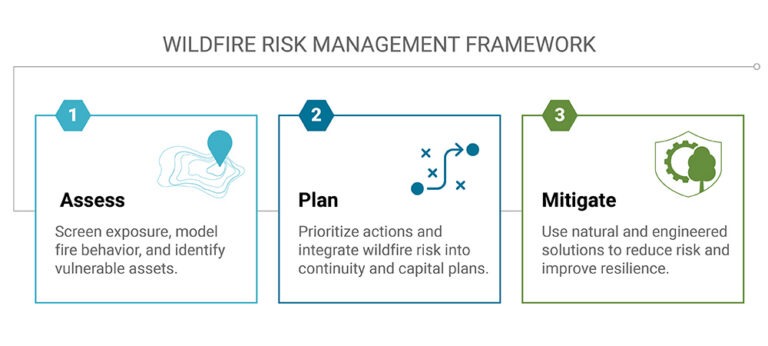
Wildfire exposure screenings can help organizations assess risks and inform mitigation options under different conditions at different levels of detail. For example, an initial high-level exposure screening can show which buildings and infrastructure systems have the most vulnerability, helping inform the later selection of mitigation actions or identify lower risk areas to guide siting decisions.
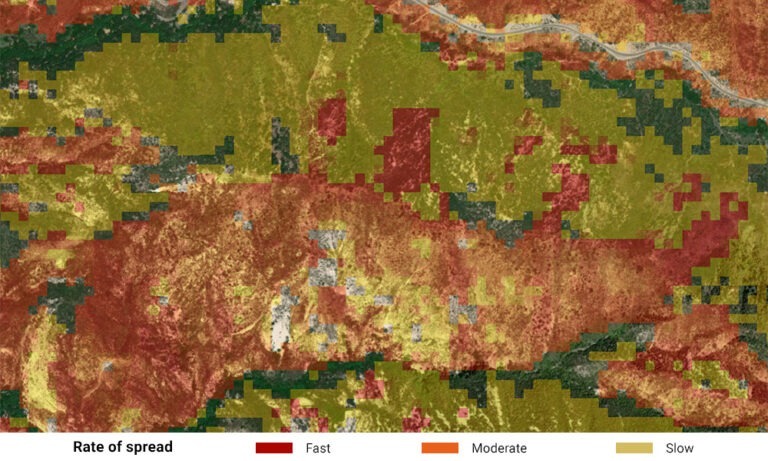
Screening can also identify vulnerabilities in the infrastructure systems that businesses depend on, including utilities, transportation, and communications. Fire behavior modeling can take exposure screenings to a more detailed level, making it possible to adjust variables such as weather conditions and fuel moisture to answer questions such as:
- How quickly will a fire spread?
- How intense will the fire be?
- Which buildings and other assets are most exposed?
- Which mitigation approaches could have the most impact?
Plan
Exposure screenings provide targeted feedback to inform short- and long-term wildfire resilience planning and identify mitigation strategies based on an organization’s goals. Organizations can then incorporate these plans and mitigation measures into larger business strategies, continuity plans, and capital plans or, for public clients, into hazard mitigation and comprehensive plans.
Mitigate
Mitigation actions can include both natural and engineered solutions. Clearing or thinning vegetation, for example, creates a natural firebreak by removing fuel. Engineered solutions include approaches like burying powerlines to prevent sparks from igniting dry vegetation and hardening structures against fire with features like fire-safe roofing and siding.
Other solutions can include working with the agencies that manage business-dependent infrastructure to understand their disaster plans and expected response times. Modeling can help identify risks and build a case for which mitigation measures to pursue and where. A mitigation outcomes screening can compare different actions — such as implementing vegetation management practices or creating a fuel break — against a control to see which options offer the best return on investment.
Where to start
Haley & Aldrich’s team has conducted wildfire risk assessments, developed resilience plans, and engineered mitigation measures for public and private clients across the country at varying scales. Our team works with clients in diverse sectors, including industrial and manufacturing, energy, and government, to develop scopes and approaches tailored to their goals, concerns, and requirements. We’ve also worked closely with agencies responsible for public infrastructure and emergency management — for example, while tracking wildfire risk to California railroads — both of which have critical influences on resilience planning for private organizations.
Contact the authors below to learn more about how we can help.

Published: 5/18/2026
- Oil and gas transmission
- Electric transmission and distribution
- Manufactured gas plants
- Renewable energy
- Government infrastructure
- Airports
- Ports, harbors, and coastal Infrastructure
- Transportation
- State and local
- Federal government
- Natural resources
- Environmental due diligence
- Environmental risk assessment
- Site characterization
- Decommissioning and demolition
- Site remediation construction
Authors

Ph.D., Wildfire Mitigation and Resilience Specialist.