Key takeaways:
- The Environmental Protection Agency’s new proposed amendments to federal coal combustion residuals regulations would make the quality of site data and documentation — not just the remedy chosen — the basis for approval.
- Owners and operators can take steps now to strengthen their data and decision-making processes in preparation.
- These steps include prioritizing sites to inform decision making, evaluating each facility holistically, closing decision-critical data gaps, and creating a permit-ready decision record.
On April 13, 2026, the Environmental Protection Agency (EPA) published proposed amendments to the federal coal combustion residuals (CCR) regulations under 40CFR Part 257. The proposal would modify portions of the legacy CCR rule and CCR management unit (CCRMU) regulatory framework to allow permit-based, site-specific compliance determinations.
For owners and operators dealing with CCR management, these amendments would change what compliance looks like. Rather than applying fixed federal standards, facilities would need to demonstrate that tailored risk-based decisions are protective, making the quality of site data and documentation — not just the remedy chosen — the basis for approval. Owners and operators can take steps now to strengthen their data and decision-making processes in preparation.
A look at the proposed legacy CCR rule amendments
The proposed amendments shift toward site-specific compliance requirements and options. Specific elements include:
- An additional compliance pathway for units closed prior to 2015 under state oversight that considered groundwater impacts and other specified criteria.
- Several options amending the requirements for CCRMUs, including certain inactive landfills, and other historical CCR placements. Some alternatives address whether some CCR placements qualify as beneficial use rather than disposal.
- A site-specific permitting pathway that would enable a federal or participating state permitting authority to approve technical requirements tailored to site conditions while maintaining the Resource Conservation and Recovery Act (RCRA) standard of “no reasonable probability of adverse effects on health or the environment.”
A shift from uniform, self-implementing CCR requirements toward site-specific, risk-based decisions made through federal or approved state permit programs could allow owners and operators to tailor certain groundwater monitoring, corrective action, closure, and postclosure care requirements to site conditions, based on conceptual site models, risk assessments, hydrogeology, exposure pathways, and receptors. That flexibility could help direct resources toward CCR units and site conditions that present the greatest risk rather than the current one-size-fits-all national minimum standards that treat risk uniformly.
The proposed amendments would not reduce the need for rigorous compliance documentation. Instead, they would place greater emphasis on the owner’s or operator’s ability to demonstrate that they can support site-specific decisions with a defensible conceptual site model (CSM), representative groundwater and geochemical data, tailored and credible exposure assumptions, and a record that satisfies the RCRA protectiveness standard.
If amendments are finalized, owners and operators will have to support site-specific decisions with:
- A defensible CSM
- Groundwater and geochemical data
- Tailored, credible exposure assumptions
- A record that meets RCRA protectiveness standard
Until an applicable permit containing these provisions takes effect, CCR unit owners would remain subject to the existing self-implementing federal requirements. Environmental nongovernmental organizations’ comments also signal where utilities may face scrutiny: incomplete CCR inventories, data gaps, CCR in contact with groundwater, and risk conclusions that rely on generalized assumptions rather than current site-specific data.
Actions to consider taking now to prepare for the legacy CCR rule amendments
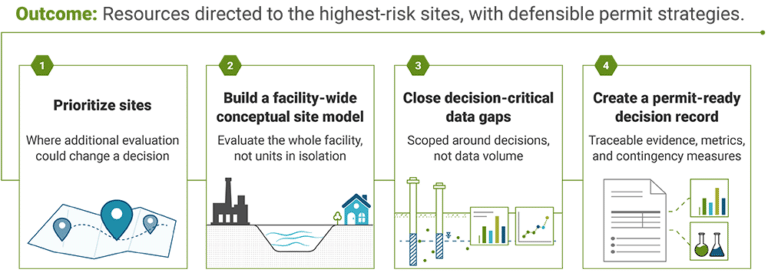
CCR unit owners and operators can prepare for these changes by focusing on four preemptive actions.
1. Prioritize sites to inform decision making
Prioritize sites where additional evaluation could help direct a risk-based program, including sites with potential receptor pathways, off-site migration, CCR in contact with groundwater, changing constituent concentrations or uncertain hydrogeology, opportunities to enhance monitoring coverage, or historical CCR placements that warrant further characterization. Sites undergoing redevelopment or with groundwater–surface-water interactions may also benefit from early evaluation.
Well-characterized sites with effective engineering controls, representative monitoring, stable conditions, and no identified complete exposure pathway could maintain established monitoring and periodically reassess conditions against defined triggers.
Why this action matters: Such prioritization can help owners and operators prepare defensible, site-specific demonstrations under proposed risk-based permitting and address monitoring network data gaps before permit decisions or corrective action milestones.
2. Build or improve a facilitywide conceptual site model
Evaluate the facility as a whole rather than treating regulated units in isolation. The CSM could include active and closed units, former impoundments, historical fills, piles, dewatering areas, beneficial-use placements, potential non-CCR sources, groundwater flow paths, and current and reasonably foreseeable receptors.
The sitewide CSM can help answer key questions. Where is the CCR? Which CCR is saturated or periodically contacted by water? Where could constituents migrate? What are the exposure pathways? This foundation supports risk-based compliance decisions. Developing or refining a facilitywide CSM supported by field measurements, hydrogeologic data, fate-and-transport analysis, and receptor evaluation would strengthen the technical basis for risk-based closure or corrective-action decisions.
Why this action matters: A robust CSM clearly identifies what is known, what is uncertain, and where more information may be needed. When historical records are incomplete or site conditions have changed, the CSM identifies assumptions and data gaps. CSMs that withstand scrutiny are supported by practical lines of evidence such as historical records, construction drawings, groundwater data, geochemistry, and information on potential groundwater flow paths.
3. Close decision-critical data gaps
Owners and operators should review whether existing data can support future permit decisions and gather important documentation for historical decisions, focusing investigations on gaps that could change the understanding of exposure pathways, source attribution, groundwater flow, plume extent, or remedy performance. They can also stress-test monitoring networks to confirm that these networks represent background conditions, cover vertical and preferential pathways, detect releases promptly, and monitor potential receptors. Targeted field data will provide a stronger basis for site-specific decisions than additional modeling built on uncertain assumptions.
Owners and operators can scope data-gap closure around decisions, not data volume alone, including:
- Whether a unit qualifies for a particular compliance pathway
- Whether the monitoring network can support a modified point of compliance
- Whether site background and established cleanup levels can be justified and supported
- Whether closure-in-place remains protective
- Whether permit conditions can be measured and enforced over time
Why this action matters: Closing decision-critical data gaps can help owners and operators work through many key issues, such as:
- Designing or refining monitoring networks that provide early and representative detection
- Distinguishing CCR-related releases from background conditions and other sources
- Evaluating alternative monitoring points, cleanup levels, closure methods, and remedies
- Defining protective permit conditions and mitigation measures
- Reducing permitting delays, redesign, duplicative fieldwork, and uncertainty
4. Create a permit-ready decision record
Document how site monitoring data, CSMs, risk assessments, and alternatives evaluations support a selected approach. Where CCR remains in contact with groundwater, monitored natural attenuation is proposed, or institutional controls help prevent exposure, bolster the record to explain how sources will be controlled, how performance will be measured and monitored, and where adaptive management tools may be helpful.
Why this action matters: It’s important to define monitoring metrics, action levels, and contingency measures before conditions change. A durable record shows why the selected approach protects human health and the environment—not simply why it costs less—and will remain useful if the EPA modifies the proposal or finalizes only certain amendments. A well-organized record allows the permit authority to understand not only the proposed outcome but also the evidence, assumptions, and decision process supporting it.
A durable record is auditable, with key assumptions, methods, inputs, decisions, performance metrics, and conclusions traceable to supporting evidence. This traceability is especially important when risk-based decisions depart from default federal criteria or rely on engineering or institutional controls, monitored natural attenuation, or long-term monitoring.
How Haley & Aldrich can help
Our CCR compliance and risk assessment professionals integrate regulatory strategy, hydrogeology, geochemistry, engineering, data management, and stakeholder communication to address complex site conditions with practical, defensible decisions. Clients rely on us to prioritize CCR portfolios, refine facilitywide CSMs, close decision-critical data gaps, evaluate risk-based closure and corrective-action strategies, and develop permit-ready records that can withstand regulatory, technical, and public scrutiny.
We know the evolving federal CCR framework
The EPA’s proposed rulemaking recognizes Haley & Aldrich’s September 2025 “Joint Data Analysis to Support Revisions to Federal Regulation of Coal Combustion Residuals” as part of the technical record supporting reconsideration of federal CCR requirements.
With our combined policy insight and multidisciplinary technical experience, we’re well positioned to help you anticipate change and develop sound strategies.
Contact the authors below to learn more.

Published: 10/27/2026
- Energy
- Coal combustion residuals management
- Brownfields
- Contaminated site management
- Environmental due diligence
- Environmental risk assessment
- Decommissioning and demolition
Authors

Senior Technical Expert, Environmental Scientist

Principal Consultant, Risk Assessment

Principal Consultant, Geo-Environmental Engineering and Industrial Waste Management